
Understanding The Vagus Nerve
Updated: Feb 8
Bridge Between Sympathetic and Parasympathetic Nervous System
This essay examines the vagus nerve and the vasovagal response as central coordinating mechanisms within the Autonomic Nervous System (ANS). The focus is not on techniques or interventions, but on understanding how a single, physically continuous nerve helps negotiate balance between activation and restraint, especially in situations involving standing, walking, aging, and recovery from stress.
What is Vagus Nerve
The vagus nerve — the 10th cranial nerve — is the longest and most widely distributed nerve in the parasympathetic ANS. It originates in the medulla oblongata of the brain-stem, and travels through the neck, thorax, and abdomen, branching extensively.
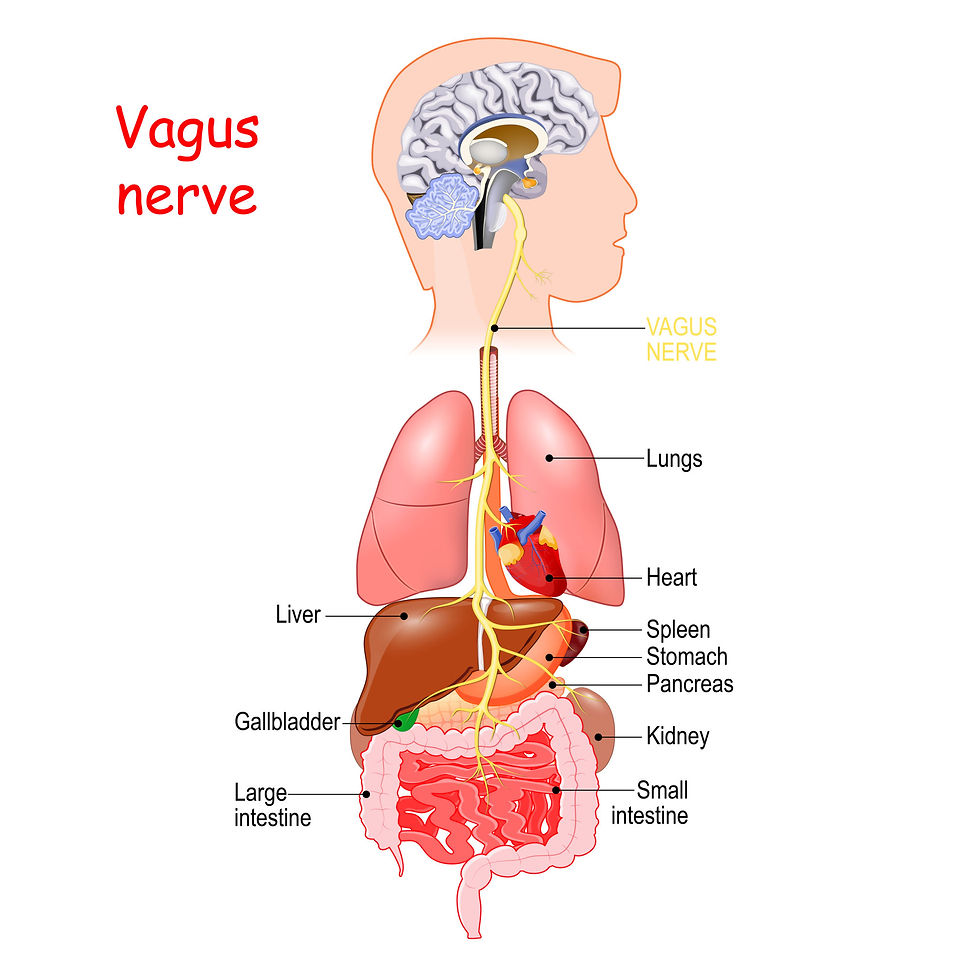
By running almost the entire length of the body, the vagus nerve is positioned to continuously sample what is happening inside—heart rhythm, breathing patterns, blood pressure changes, gut activity, throat tension, and visceral strain—and relay this information back to the brain.
A nervous system organized around such continuous feedback does not function as a simple on–off switch.
The Nervous System Is Not a Switch
The nervous system is commonly described as a simple toggle: sympathetic for action and parasympathetic for rest. In reality, this binary view hides the most important part—the coordination between them.
The body is rarely fully sympathetic or fully parasympathetic. Walking, standing, digestion, speech, and emotional regulation all require rapid, moment‑to‑moment negotiation between the two. This negotiation does not happen automatically. It is mediated.
That mediator is largely the vagus nerve.
The Vagus Nerve as an Integrative Pathway
The vagus nerve is not merely a parasympathetic nerve. It is a bidirectional information highway linking the brainstem with the heart, lungs, gut, throat, and inner organs.
A majority of its fibers carry information from the body to the brain, not the other way around. This means posture, breath, gut state, and cardiovascular signals continuously shape brain tone, attention, and emotional regulation.
This is why psychological states cannot be separated from physiology. The brain is constantly listening to the body through vagal pathways.
Vasovagal Response: A Window Into the System
The vasovagal response is often discussed only in terms of fainting. This narrow view misses its broader meaning.
A vasovagal episode represents a sudden, uncoordinated shift in autonomic balance—heart rate drops, blood vessels dilate, cerebral perfusion decreases. What looks like a failure is actually an exaggerated protective reflex.
The important insight is this: the same pathway that can cause collapse under stress is also responsible for recovery, calming, and regulation when properly coordinated.
Balance, Walking, and Autonomic Coordination
Balance and walking are not purely musculoskeletal acts. They depend on precise autonomic timing.
Standing upright requires subtle sympathetic activation to maintain blood pressure, paired with parasympathetic modulation to prevent overdrive. The vagus nerve helps synchronize this exchange.
When this coordination weakens—due to aging, illness, or chronic stress—people experience dizziness, instability, fatigue, or sudden drops in confidence while walking.
This explains why balance training alone sometimes fails. The issue is not strength, but signaling.
Why Mindfulness Works Through This Pathway
Mindfulness influences the nervous system not by thought control, but by altering incoming signals.
Slow attention to breath, bodily sensation, posture, and sound changes vagal afferent input to the brain-stem. Over time, this stabilizes autonomic reflex loops.
Neuroplasticity — the brain's ability to reorganize its structure, functions, and connections in response to experiences, learning, injury, or environmental changes —follows the same pathway, because repeated, regulated signaling reshapes how the brain predicts safety and threat.
Without understanding this pathway, mindfulness appears philosophical. With it, mindfulness becomes physiology.
Aging, Fragility, and Autonomic Resilience
With age, vagal tone often diminishes—not suddenly, but gradually. This contributes to slower recovery from stress, poorer balance, digestive irregularity, and increased fear responses.
Importantly, this is not irreversible decline. Autonomic pathways remain plastic well into later life, provided signals are consistent and non-threatening.
The goal is not stimulation, but coherence.
A Bridge, Not a Lever
The vagus nerve is not a lever to be pulled or a nerve to be forced into action. It is a bridge that responds to context.
Practices that respect this—gentle movement, mindful breathing, upright posture, safe attention—support coordination rather than dominance of one system over another.
This perspective dissolves the false opposition between sympathetic and parasympathetic activity. Health lies in their dialogue, not their suppression.
Closing Perspective
Understanding the vagus nerve changes how we view fear, fainting, balance loss, aging, and healing. It connects mindfulness to muscle tone, breath to cognition, and posture to emotion.
When this bridge is understood, mindfulness and neuroplasticity stop being ideas. They become expressions of an underlying biological conversation—one that can be supported, retrained, and respected at any age.

Comments